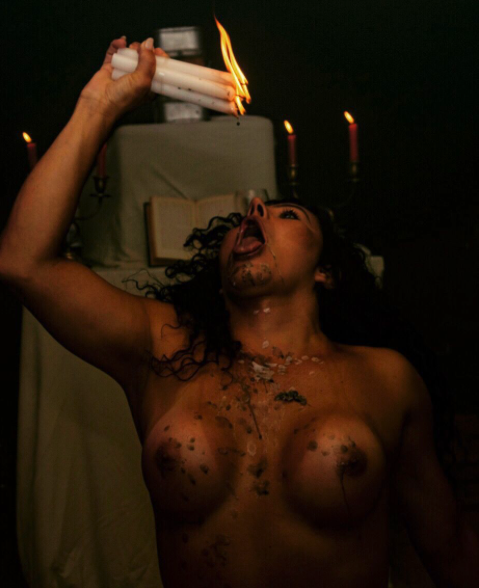
The Portuguese Platform for Performing Arts – a biennial event where the most relevant works of Portuguese performing arts are presented to a hundred national and international programmers, curators, and artistic directors. This has been the most important platform for the internationalization of Portuguese performing arts. “My Profane Holy Body” is a performance by the founders of TransParadise, Keyla Brasil and Freda Paranhos, that investigates corporeal and gender insurgencies through the mimesis of their own lives. The Travesti identity is a South American identity, still denied by the gender coloniality (which operates the dehumanization of individuals who do not fit within hierarchical binaries). As confirmed by Letícia Nascimento (2021), travestis are outsiders to gender, often having a place denied within feminism, thus needing to negotiate socio-cultural relations beyond cis-hetero-patriarchal power dynamics.
Becoming has always been and continues to be a contested territory. Becoming as a multiple field, existing within a border between possibility and desire, as defined by Deleuze and Guattari (2012), is about trans-formation. In “My Profane Holy Body,” performer KEYLA BRASIL elaborates on subjectivities related to TRANSforming, where becoming-trans and multiple femininities relate to pleasure and pain.
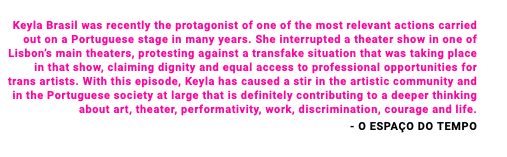
This performance was created to provoke reflection among European cisgender identity, and it was much more than a piece intended to be sold or captured by white, cisgender European curators for their home countries. It was a manifesto that trans, migrant art is untamable, uncontrollable, and irrevocably present. Unlike other selections, the performance was not purchased, nor did it have a journey through Europe after the exhibition.
Guess Why?
DELEUZE, G; GUATTARI, F. Mil platôs – capitalismo e esquizofrenia 2. Vol. 4. São Paulo: Editora 34, 2012b (2ª Edição). · NASCIMENTO, L. Transfeminismo: Feminismos Plurais. Sueli Carneiro, Jandaíra. São Paulo, 2021.