WHAT THE MEDIA SAID
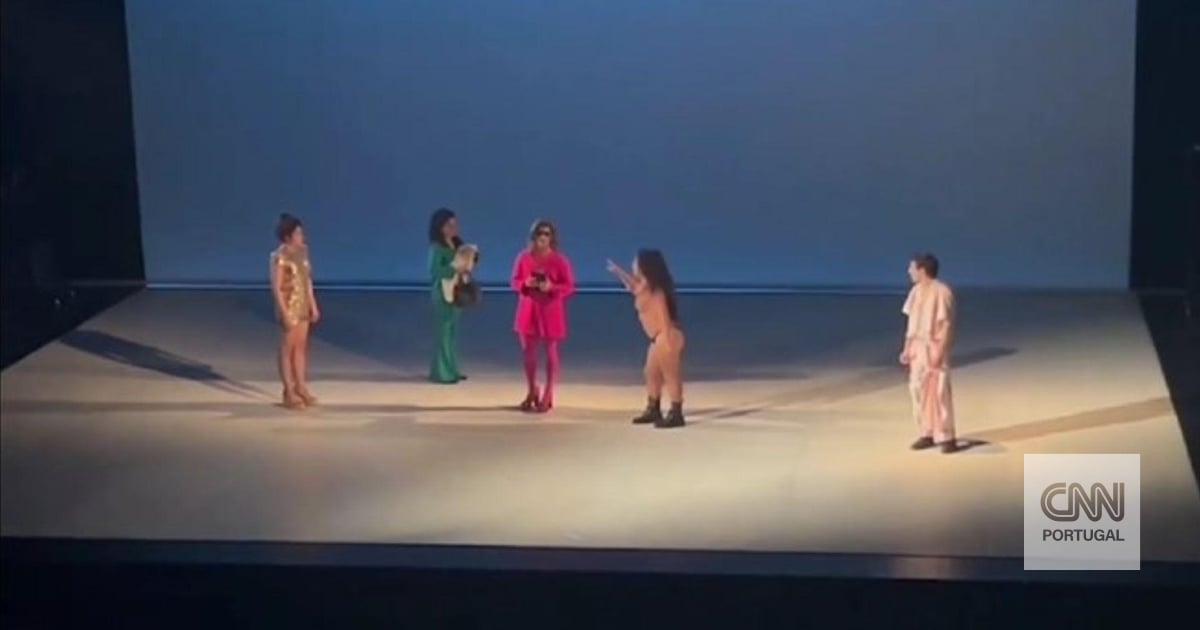
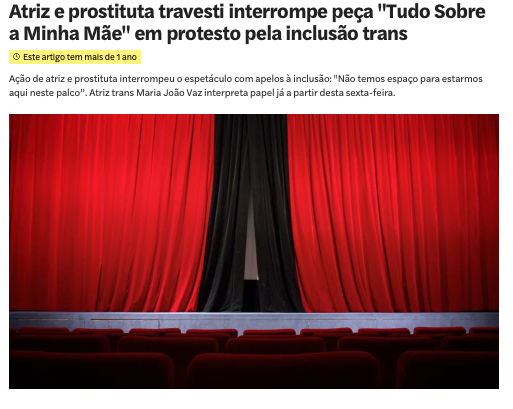
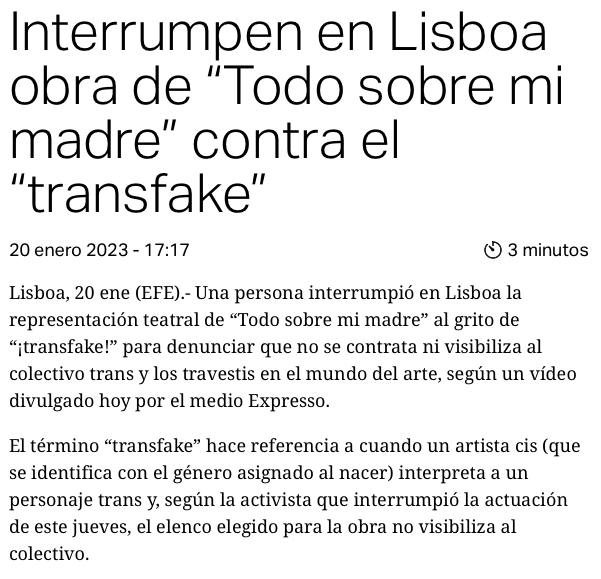
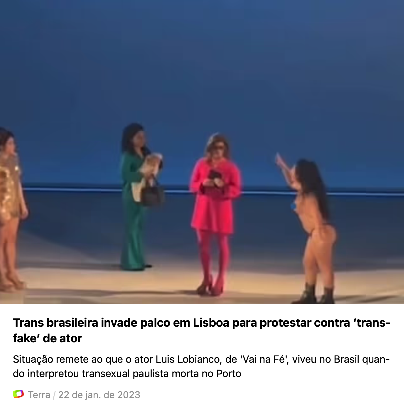
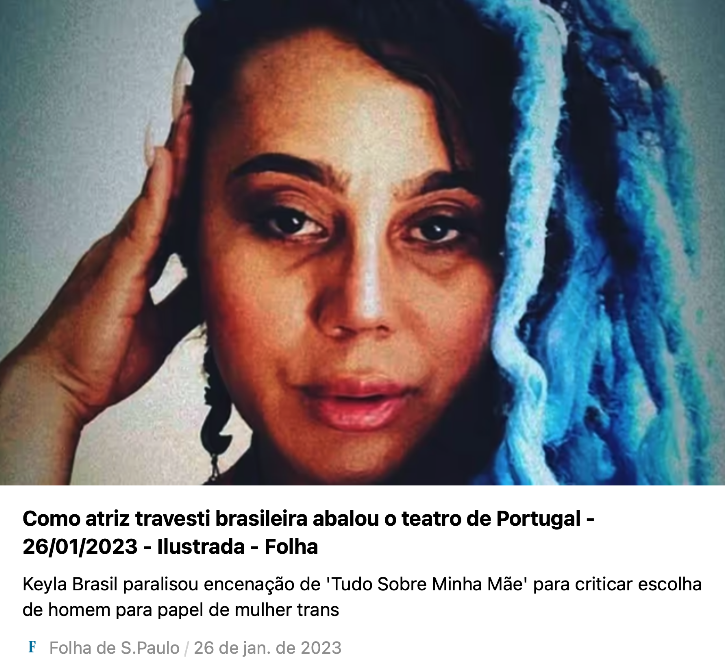
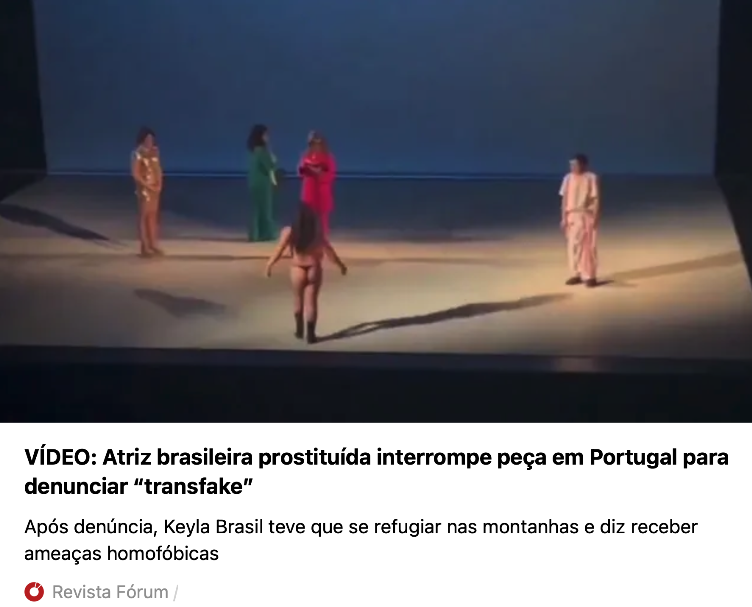
The invasion of Teatro São Luiz by the actress and trans activist, one of the founders of TransParadise, Keyla Brasil, occurred during the performance of the play “All About My Mother.” Keyla protested against the lack of representation of transgender actors, specifically contesting the choice of a cisgender actor, André Patrício, to portray a transgender character in the play. During the protest, she expressed her outrage and highlighted the difficulty that transgender individuals face in finding opportunities in the arts in Portugal, relating it to her own experience as a sex worker.
Keyla’s action on stage was met with applause from the audience and sparked a dialogue with other artists present.
Actress Maria João Luís and artist Gaya de Medeiros acknowledged the significance of Keyla’s gesture in the transgender struggle. After the incident, Teatro do Vão, responsible for the staging of the play, expressed solidarity with Keyla’s fight and announced the replacement of André Patrício with transgender actress Maria João Vaz.
This event marked a significant milestone in the discussion about representation and inclusion of transgender people in the arts in Portugal, drawing attention to the need for more inclusive and representative spaces.
POLITICAL REPERCUSSIONS
There was a vote to decide whether the government supported or condemned the act. The approval of a vote of solidarity with theater professionals, while also rejecting accusations of transphobia in the play “All About My Mother,” indicates an attempt to balance artistic freedom of expression with emerging social concerns. This vote, proposed by the Culture Councilor, Diogo Moura, reflects a crucial turning point in the dialogue between art and politics. The approved vote of solidarity, while recognizing the right to protest, also underscores an attempt to balance artistic expression with emerging social sensitivities. The response from the government highlights the impact and importance of protest acts like Keyla’s, capable of transcending the stage and sparking substantial political discussions.
The divergence of opinions among council members, with some expressing solidarity with the transgender struggle and others advocating for artistic freedom of expression, illustrates the complexity of the issue. The decision to bring TransParadise’s protest to a vote reveals the need for a deeper debate on inclusion and representation, not only in the arts but also in the formulation of cultural policies and practices.



OUR REFLECTIONS
On January 19th, we mark the anniversary of an act that redefined the contours of the contemporary stage in Portugal. TransParadise challenged colonial structures. The act of “discovery” of the stage, far from being an invasion, was a claim for space, a living manifesto. By choosing a moment of high artistic visibility, we not only brought to light the marginalization of trans bodies in the arts but also questioned who has the right to claim spaces of expression (Mignolo, 2007).
In an industry that often hides behind art to perpetuate the status quo, Keyla, who discovered the stage, reminded us that stages are grounds for struggle and identity affirmation. Keyla’s insurgency is a practical application of decolonial theories, which seek to dismantle the continuity of colonialism in modernity (Quijano, 2000). Her action challenges the narrative that art is neutral and reminds us that every stage carries within it the history of exclusions and silencings.
Keyla Brasil, through her action, embraces the counter-colonial movement, which not only responds to colonization but also acts as a form of cultural resistance and agency recovery (Césaire, 1955). Her protest is a statement that trans and migrant art is indomitable, uncontrollable, and irrevocably present.
“Hija de Perra” (2014) questions: Do we exist only since they discovered us? “It seems that our voice is only valued when the dominant finds us, makes us exist. As if the history before colonization did not exist, and everything started from the discovery of America for these individuals who did not even know where they were and that we had been free from their filthy miseries for many years.” (p.2)

Another interpretation of the word “discovery” in this context brings up the idea of revealing and unveiling hidden truths. Semiotically, “discovery” can be understood as a process of removing the veil or exposing something (and oneself) that was concealed, bringing to light previously ignored or deliberately hidden aspects.
In this context, “discovery” transcends mere physical action; it becomes a symbolic act of resistance and empowerment. Keyla, by “discovering” the stage, strips theater of its traditional conventions and proposes a new way of understanding and experiencing art. She challenges the audience to see beyond surfaces, to recognize the layers of meaning and hidden history beneath established cultural and social norms.
One year after TransParadise’s protest, its reverberation still challenges the deeply rooted colonial norms in the arts. The need to decolonize the stage – and our own perceptions – remains urgent. As we celebrate this anniversary, we must also reaffirm our commitment to the fight for equity and true inclusion.
The work is far from over, and we must continue to uplift marginalized voices and create spaces for underrepresented communities. It’s important to acknowledge how the arts have historically excluded certain groups, and actively work towards dismantling these oppressive systems. Decolonizing the stage means more than just diversifying casting choices or hiring practices. It requires a fundamental shift in the way we approach storytelling and the types of narratives that are deemed valuable. We must challenge the dominant narratives that have been perpetuated for centuries and make room for new, diverse perspectives.
References: Césaire, A. (1955). Discourse on Colonialism. Monthly Review Press. · Mignolo, W. (2007). The Decolonial Option: Towards a Non-Colonial Living. In Local Histories/Global Designs: Coloniality, Subaltern Knowledges, and Border Thinking (pp. 1-22). Princeton University Press. · Perra, H. d. (2014). Dirty Interpretations of How Queer Theory Colonizes Our Sudaca Context (p. 2). Revista Periódicus 2nd edition. · Quijano, A. (2000). Coloniality of Power, Eurocentrism, and Latin America. Nepantla: Views from South, 1(3), 533-580.